Test PRs exactly how theybehave in production.
The ultimate pre-merge safety net for high-velocity teams. TraceMain spins up a production-like sandbox, runs your test suite, and executes smoke tests on every PR to catch regressions before they reach your users.
# Install the TraceMain GitHub App
$ gh app install tracemain

# TraceMain intercepts PR #4471
→ PR opened. Spinning up isolated sandbox...
→ Sandbox ready. Running E2E & smoke tests...
→ Analyzing diff context & metrics...

! HIGH RISK: P99 latency 340ms vs 80ms baseline on /checkout.
! HIGH RISK: Error rate spiked to 4.2% in sandbox.

# Action taken by TraceMain
→ GitHub Status Check set to FAILED.
→ Risk report commented on PR. Merge blocked.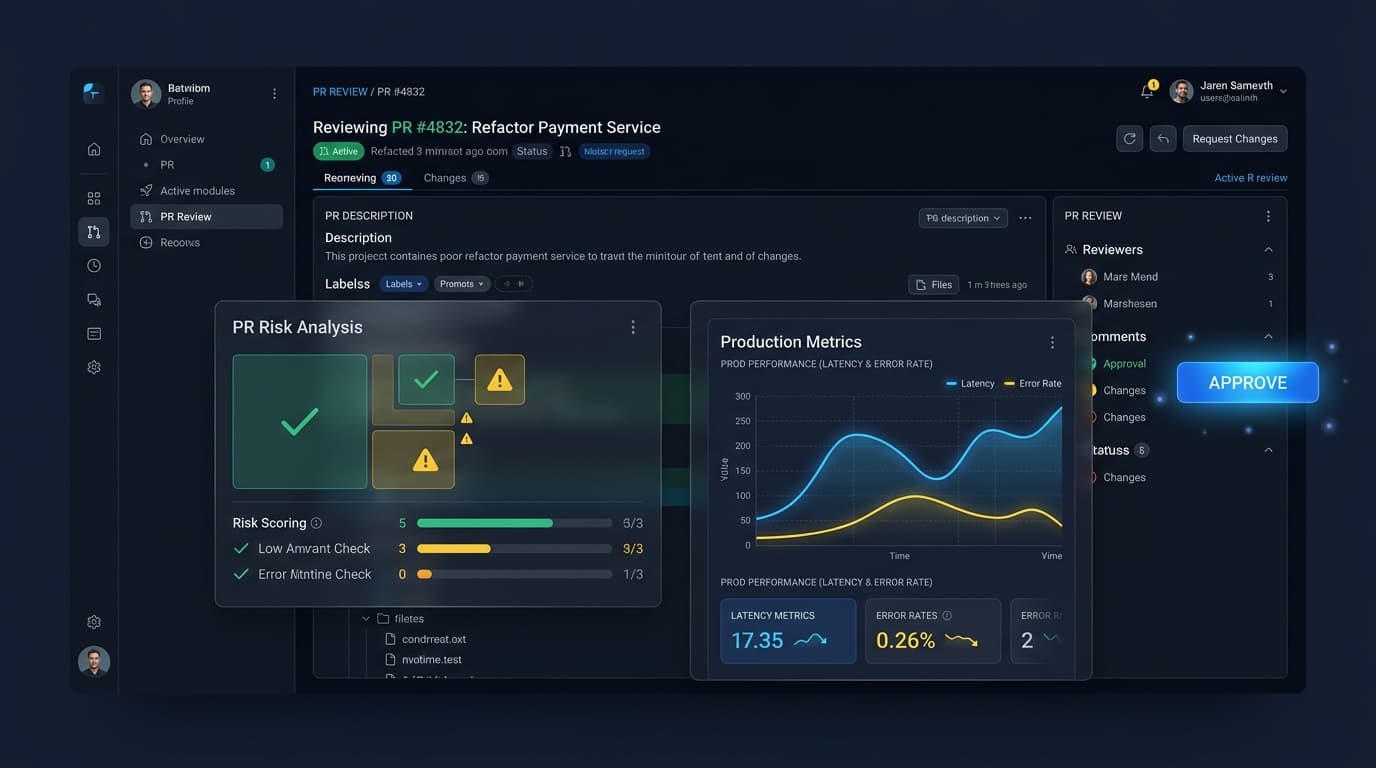
PRs analyzed in beta
Regressions caught post-merge
Post-merge monitoring window
Auto-merges. Ever.
From PR to production. No gaps.
// TraceMain Agent Traceasync function handleMerge(pr: PR) {const risk = await analyzeDiff(pr.diff);if (risk.level === "HIGH") {await notifyReviewers(risk.summary);}const metrics = await watchProduction(pr.id);if (metrics.regressed) {await proposeRollback(pr.id);}}A PR opens. TraceMain gets to work.
It analyzes what the change actually touches — not just the diff, but the risk patterns. Modified retry logic, new external calls, changes to payment paths.
Risk report posts to the PR.
A plain-language summary of what the change touches and why it matters. A human reads it and decides whether to merge. Nothing merges on its own, ever.
After merge, production gets watched.
Error rates, latency, the signals that actually tell you if something broke. Not a generic dashboard — the specific things this change could affect.
If something regresses, you hear about it.
It explains what changed and proposes a rollback with reasoning. A human approves before anything reverts. A false positive is a notification you close, not a rollback you didn't ask for.
Beyond basic CI checks.
Context survives the merge.
Most tools lose the thread the moment code is merged. We map the original PR directly to the post-merge production metrics.
Zero auto-rollbacks. Ever.
We propose. You decide. When a regression is caught, you get a one-click rollback proposal, not an unexpected deployment.
2am
No more PagerDuty wakeups.
Plugs into your stack.
Reads from GitHub. Queries Grafana. That's it. No agents to install on your servers.
Prod-like Sandbox Testing.
We don't just stare at the code. TraceMain automatically spins up an isolated sandbox environment, routes synthetic traffic, and maps the PR's behavior against your current main branch before you even click merge.
The agent proposes. You decide.
Two non-negotiable approval gates. No exceptions.
Nothing merges without a human.
The agent presents its analysis. You make the call. No auto-merges, no silent approvals.
Nothing rolls back without a human.
Regression detected? The agent explains what it found and proposes a revert. You approve or dismiss.
Every decision is logged.
Full audit trail. Every analysis, every tool call, every decision point — timestamped and traceable.
Join as a design partner
We're looking for engineering teams with real repos who want to close the gap between “CI passed” and “production is fine.” This is early. We want to build this with you.